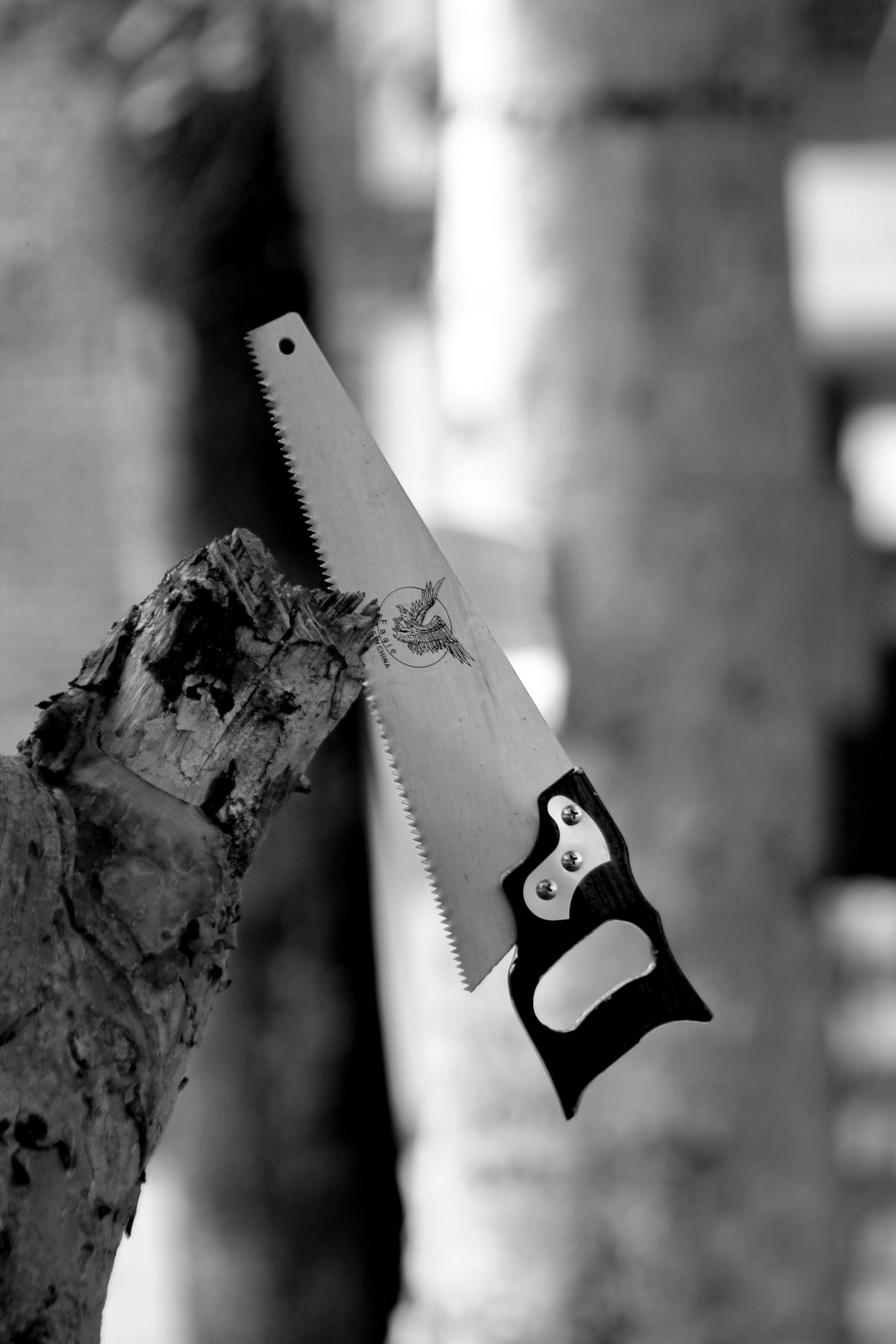
A saw can move smoothly through a piece of wood—until it reaches a knot.
The saw has not changed, and neither has the task. But one knot in its path suddenly demands more force, more time, and more effort.
Not every difficulty is of our own making, of course. Some knots are already there. Some things are genuinely difficult, and there is no shortcut through them. They simply require time and effort.
But some knots are of our own making. Some of the difficulty comes from what we add ourselves.
We add a step we do not need, hold on to a condition we could let go of, or try to convince someone who does not want to be convinced. We postpone an obvious decision because we want a guarantee that does not exist, then think about one possibility, the possibility behind it, and eventually build a backup plan for a problem that has not even happened.
Then, after creating all that complexity, we look at our lives and say: life is hard.
Maybe.
But how many knots did we put in front of the saw ourselves?
There is something strange about our relationship with difficulty. If something takes ten hours, it somehow feels more valuable than something we finished in one. If we find a simple solution to a complicated problem, we become slightly suspicious of it. Surely we must have missed something.
As if the right solution should hurt a little.
We are often more impressed by someone who does everything alone than by someone who built a system that does not require them to be involved in every detail.
And sometimes we take pride in our ability to endure things we would have been wiser not to carry in the first place.
But difficulty is not a measure of quality. You can reach the same destination by a long road or a short one, and the result does not become more valuable simply because you arrived exhausted.

The Bag We Never Opened
Imagine someone carrying a heavy bag on a long journey. After an hour, their shoulder begins to hurt, so they decide the solution is to become stronger. They tighten the strap, adjust their posture, and keep going.
Two hours later, the pain gets worse, so they tell themselves they need more patience.
But they never stop to ask one simple question:
What is actually inside the bag?
Maybe half of what they are carrying is unnecessary.
It is a question we rarely ask.
When our days become overloaded, we look for better ways to manage our lives instead of asking why we put so many things into a single day. When responsibilities pile up, we try to become more disciplined instead of asking which of those responsibilities were ours in the first place.
When a relationship drains us, we search for a new way to explain, justify, and repair things before asking whether all that explaining is necessary at all. We may spend a long time searching for the right way to fix a relationship, convince someone, or explain the same situation for the tenth time, while avoiding a much simpler question:
Does this really need another attempt?
Perhaps we are very good at strengthening our shoulders, but less skilled at opening the bag.
But the problem is not always that we failed to see the simpler solution.
Sometimes we see it clearly and deliberately move away from it.
Because simplicity, in some situations, forces us to make a decision.
You may have a problem that requires one phone call. But that call might bring an answer you do not want to hear. So instead, you think, analyze, ask other people, and wait for the right moment.
Not because the problem is complicated, but because complexity postpones the moment of confrontation.
You may know that you do not want something, but instead of simply saying “no,” you begin searching for enough reasons to make your refusal acceptable to everyone.
Or the decision may already be clear, but you keep collecting information because you want to reach a point where you are one hundred percent certain.
That point usually never comes.
Sometimes the knot is not in the problem.
The knot is our need for a guarantee that the decision will cost us nothing.
The Knots We Tie Ourselves
Some knots also come from the conditions we attach to what we want.
We want a good job, but with too many conditions attached. We want a successful relationship, but we also want never to disagree, never to be misunderstood, never to be rejected, never to compromise, and for the other person to behave exactly as we expect.
We want to start a project, but only after the idea is complete, we have enough time, we feel confident, and we somehow already know the outcome.
Little by little, the problem is no longer reaching what we want. The problem becomes insisting that it happen exactly the way we decided it should.
Sometimes you do not need to give up the goal. You only need to let go of some of the conditions surrounding it.
And from there comes another knot, perhaps an even more difficult one: confusing our ability to do something with the necessity of doing it.
We tell ourselves we can manage everything on our own, tolerate the situation a little longer, keep working this way to fix it, and keep going.
All of that may be true.
But “I can” does not always answer the question: “Why am I doing this?”
The strange thing is that we can feel proud of handling everything alone, only to spend the rest of our time recovering from it.
Sometimes strength is knowing what was never worth carrying in the first place.
Being able to carry a heavy bag does not mean everything inside it is necessary. And being able to cut through a knot does not mean you need to put one in front of the saw.
What Is Making This Harder Than It Needs to Be?
When something in life becomes exhausting, our automatic question is often:
How do I deal with all of this?
We should ask instead:
What is making this harder than it needs to be?
It may be something you can remove. An expectation to let go of. A decision you keep postponing. A responsibility that was never yours. Or an ongoing attempt to control an outcome that is not in your hands.
The point is not to make life easy at any cost. Some things are worth the effort. Some roads have no shortcuts, and some stages of life require patience and work.
But that is exactly why it makes sense not to waste our energy on additional difficulty we created ourselves.
Maybe we do not always need to ask how to become more patient, more organized, or better at enduring. Sometimes we need to ask a simpler question:
What am I exhausting myself trying to handle when I may never have needed to carry it in the first place?
Life will put enough knots in the wood on its own.
We don’t need to put more in the saw’s path.
Further Reading
- Maxim Gorky: A Life Harsher Than His Novels
- The Strange Habit That Helps Your Brain Make the Right Decision Under Pressure… Before the Pressure Begins
Explore the books behind Zenya Journal
If you want more than just ideas, explore the free resources at Zenya Journal and start putting them into practice.
Share your thoughts