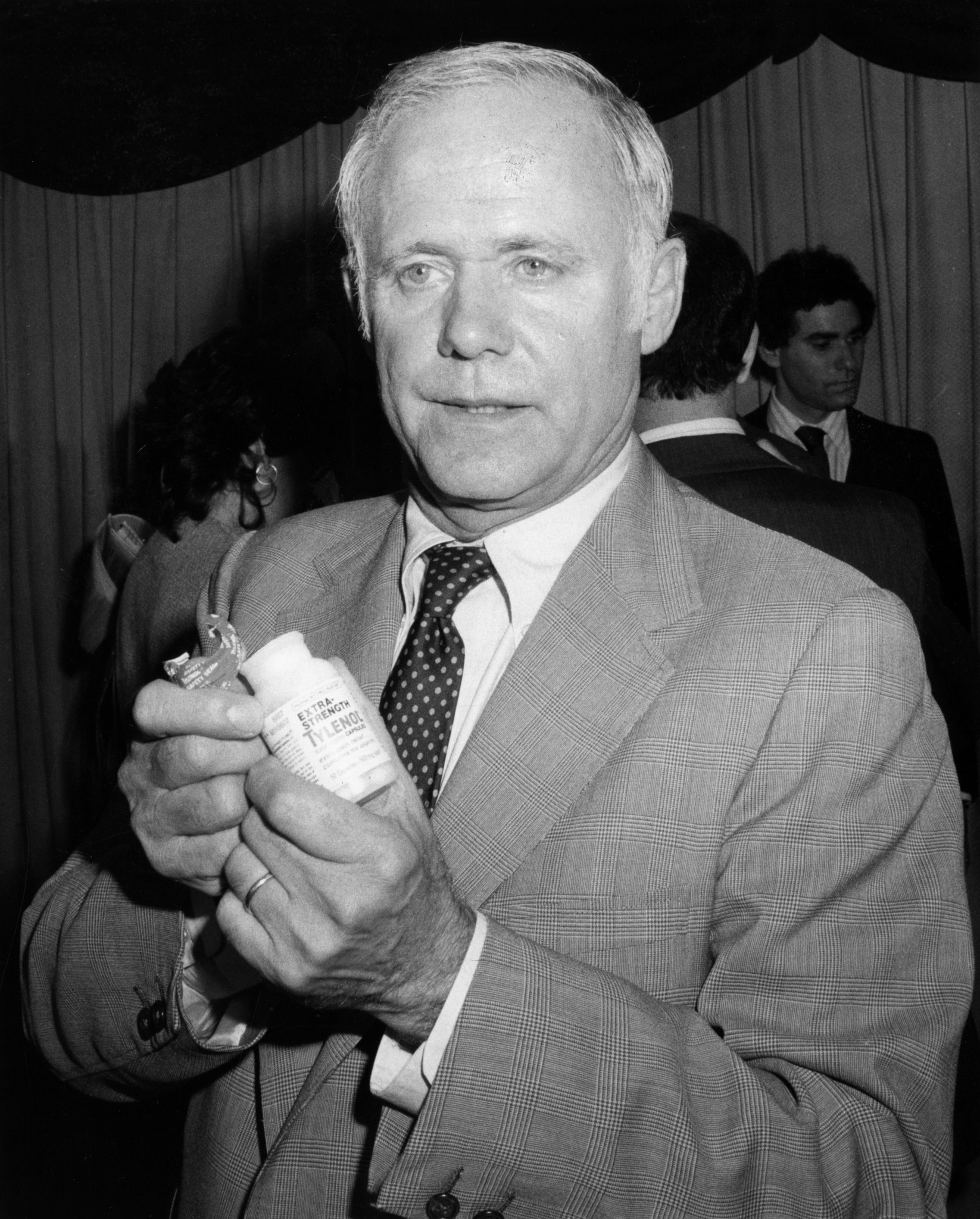
On the morning of September 29, 1982, a family in a Chicago suburb woke up to a sick child. Mary Kellerman was twelve years old. She had a sore throat and a runny nose, so her parents gave her an Extra-Strength Tylenol capsule.
Hours later, Mary was in the hospital. Then she died.
At first, no one knew that her death would become the beginning of a crisis that would reach millions of Americans. There was a child who had died suddenly, followed by other cases appearing around Chicago.
Adam Janus, 27, took Tylenol for a minor pain. He died too. His family gathered at his home after his death. His brother Stanley and Stanley’s wife, Theresa, had headaches, so they took capsules from the same bottle.
Within a short time, both were dead.
Something was happening. Within days, the death toll had reached seven.
The one thing connecting them was sitting in the medicine cabinets of millions of Americans: Extra-Strength Tylenol capsules.
Then came the discovery of cyanide.
This was not an incorrect dose or a rare side effect. Someone had opened bottles of the medicine, put cyanide into some of the capsules, and returned them to store shelves.
But none of that was known from the beginning.
In New Jersey, the problem was reaching James Burke, the chief executive of Johnson & Johnson.
Tylenol was one of the most successful pain relievers in the United States. It held about 35% of a pain-reliever market worth roughly $1.2 billion.
Suddenly, the product’s name was appearing beside one word: cyanide.
Burke and his team did not have the luxury of waiting for the investigation to end. They had to decide before they knew the whole story.
The problem was not the bottles they had found
If the company had known that only seven bottles had been tampered with, the decision would have been simple: recall them, identify the stores that sold them, and close the case.
But no one knew how many bottles were poisoned. At first, it was not even clear where the tampering had happened. During manufacturing? During distribution? Or was someone buying bottles from stores, opening them, adding poison, and putting them back on the shelves?
Each possibility led to a different decision.
If the tampering was local, recalling millions of bottles across the United States would be an enormous response to a limited crime.
But what if it was not local?
Every hour of waiting could mean another person opening a medicine cabinet at home.
There was no equation that could give Burke the answer. There was only a cost attached to every choice.
One hundred million dollars against something that could not be measured
Johnson & Johnson began recalling the product, then made the decision that would turn the crisis into a case study for decades.
The recall would not be limited to Chicago. Tylenol would be withdrawn nationwide.
31 million bottles.
The operation cost about $100 million — in 1982, by most accounts of the crisis. No one could promise the company that it would recover that money.
Before the deaths, Tylenol held about 35% of the pain-reliever market. After the crisis, its share collapsed to roughly 7%.
The question was not simply whether the company could afford the recall. It was whether it would spend $100 million to save a product that people might never want to buy again.
Burke had no evidence that the decision would restore public trust. He had no financial model telling him that market share would return. And he did not know whether the crisis would end with seven deaths or whether it had only just begun.
But he had something else.

The decision had been written forty years before the crisis
Since the 1940s, Johnson & Johnson had operated under an internal document known as Our Credo.
Its order of responsibility was clear: customers first, then employees, then the community, and finally shareholders.
Years later, when Burke was asked about the Tylenol decision, he did not say that he had known how the crisis would end. He said the Credo had given him what he needed to persuade shareholders and others to spend $100 million on the recall.
One of the most famous decisions made under pressure in corporate history did not begin when the first poisoned bottle appeared. Part of it had been made decades earlier.
The company had already decided what came first when consumer safety conflicted with money.
On ordinary days, statements like these can look like the language companies put on walls and websites.
In September 1982, they had a price: one hundred million dollars.
Then the company did something else
It did not try to make people forget what had happened. It did the opposite.
It warned consumers, stopped advertising and production related to the capsules, opened direct communication lines, and removed the product at the center of the crisis from the market.
Then it began thinking about a harder question:
How do you make someone see the name Tylenol without thinking of cyanide?
The answer was in the packaging itself.
When Tylenol returned to the market about two months later, it came in tamper-resistant packaging: barriers and seals that made the bottle harder to open and manipulate, and made interference more visible to consumers.
The crisis changed more than Tylenol. After the deaths, the U.S. Food and Drug Administration introduced new requirements for tamper-resistant packaging, followed by a federal law criminalizing the deliberate tampering of consumer products.
Seven deaths changed the way medicine bottles were packaged in America.
As for Tylenol, its market share rose from 7% to about 30% by the middle of the following year, then approached its previous level by the end of 1983.
We know those numbers now.
Burke did not know them when he made the decision.
What do you do when you have to decide before you know enough?
Most difficult decisions do not arrive with complete information. If they did, they would not be so difficult.
Burke did not have a lab report telling him where the tampering happened, or a forecast telling him what the recall would cost him in the end. He had a closing window and a question he could still answer honestly. That is closer to most of the decisions we actually face than we like to admit.
A job opportunity appears, but you do not know whether the new company will succeed. A relationship ends, and you do not know whether you will regret it six months later. An investment appears, but you cannot see the future. You need to leave a place, start a project, reject an offer, accept a risk, or say something you cannot take back.
Then the mind begins trying to buy more time: one more piece of information, one more opinion, one more day, one more phone call, one more search.
Sometimes that is intelligence. Sometimes it is simply fear dressed as analysis.
The problem is that some decisions have a window, and the information that would make you completely certain may arrive after that window has closed.
What Burke did does not offer a rule that says: always choose the most expensive option, the safest option, or the most ethical one.
It offers something simpler.
When you cannot know the outcome, change the question.
Instead of asking, “Which option will give me the best result?” ask, “Which outcome could I not accept having contributed to?”
That is roughly what made the Tylenol equation different.
Losing one hundred million dollars was a severe outcome, but it was repairable.
Another person dying because the company waited for more information?
That was not.
Suddenly, not all risks were equal.
This is why you need your rules before the crisis
There are decisions you should not begin thinking about only when they arrive. Parts of them should already be settled.
What would you refuse to do for money? What would make you leave a relationship, no matter the cost of leaving? When does protecting your reputation become less important than telling the truth? How much loss are you willing to accept to protect something you consider non-negotiable?
These are not philosophical questions. They are a way to reduce the number of decisions you will have to make while you are afraid.
Take the reputation question. You will not answer it well in the middle of the situation that tests it — when your name is already attached to the mistake and everyone is watching how you respond. Answer it now, on an ordinary day, in one sentence you could repeat later: “I would rather lose the deal than lie about what happened.” Write it down if that helps it hold. That sentence is not a plan for every future crisis. It is one less decision you will have to make while under pressure — the way the Credo had helped Burke make his decision, forty years before he needed it.
Pressure does something simple to the mind: it makes what is close seem larger. The loss that will happen today looks enormous, while the damage that may happen a year from now feels distant.
That is why the easiest financial decision in the Tylenol crisis was to protect the product as much as possible. The hardest financial decision was to take it off the market.
But more than forty years later, no one remembers the hundred million dollars as the loss that nearly killed Tylenol.
We remember it as the price the company paid so people could trust the bottle again.
A good decision under pressure does not always require more information. Sometimes it requires something that comes before information: a principle that tells you which losses you can repair, and which losses you do not want to live with.
James Burke did not know how the Tylenol crisis would end. He only knew where to look when the calculations were no longer enough.
Further Reading
- The Strange Habit That Helps Your Brain Make the Right Decision Under Pressure… Before the Pressure Begins
- The Knot and the Saw: Why Do We Make Life Harder Than It Needs to Be?
- How to Make Better Decisions Under Pressure
Explore the books behind Zenya Journal
If you want more than just ideas, explore the free resources at Zenya Journal and start putting them into practice.
Share your thoughts